Errors Taught About the Sacraments After the Second Vatican Council
Is Penance Relevant? Are the Gospels True? Do We Need Priests? Why Are Some Catholic Leaders Even Asking These Questions?

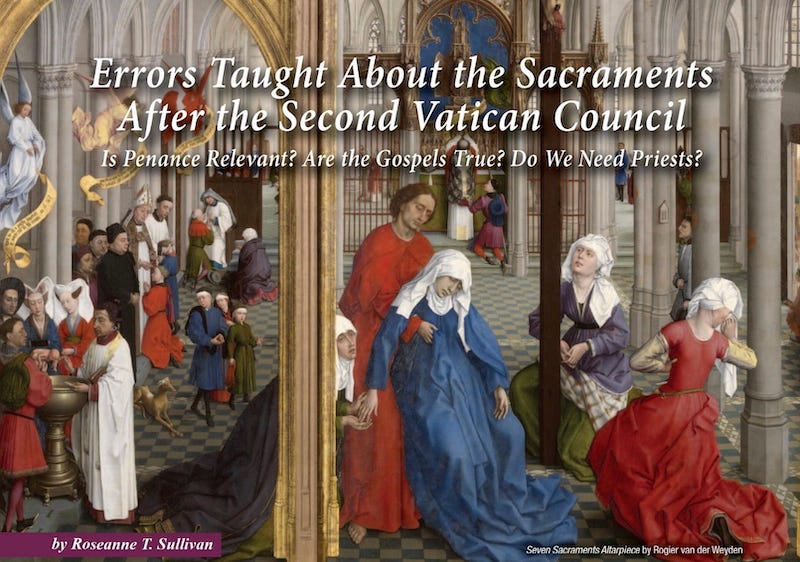
This article is about a four-week course about the sacraments taught by His Excellency, the late Bishop of San Jose, Patrick McGrath, which I took in the Fall of 2003 at the bishop’s diocesan Institute for Leadership in Ministry (ILM). The details are based on my notes from the course, as well as on an article I wrote back then for the San Francisco Faith newspaper, titled “Is Penance Relevant? What San Jose Diocese Teaches Lay Leaders about the Sacraments.” This article was published in The Latin Mass journal in the Spring 2026 edition and has been revised and expanded.
This article is a follow-up to another article published in 2025 about what I learned at the ILM, titled, “Why Do Many Catholics Hold Contradictory Beliefs?” It was first published in The Latin Mass journal and republished on this Substack. In that article, I reported on the teachings of Reverend James T. Bretzke, S.J., a respected moral theologian who has been teaching at Catholic universities and seminaries for decades. I learned about Father Bretzke’s teachings in a course in moral theology I took at the ILM, and I contrasted his teachings with what is taught in official documents of the Catholic Church.

As I mentioned in the previous article, the ILM was founded to train non-ordained men and women for parish leadership.
I am writing this series to share with other Catholics who may be baffled, as I often have been, to realize how many who identify as Catholics do not believe in or live according to the Church’s traditional teachings. To my dismay, I discovered that many teachers in positions of authority in the Church: bishops, pastors, parish priests, religious brothers and sisters, and lay catechists, who teach in Catholic churches, schools, colleges, and universities, are followers of certain liberal theologians writing after the Church’s Second Vatican Council, and they teach theological positions as if they are the official teachings of the Church— even when the positions contradict Church teachings and have specifically been condemned by Rome.
When I checked with some of my classmates, I found I was alone in my rejection of Father Bretze’s claims that morality had changed after Vatican II. It was additionally painful for me to hear in the ILM course taught by Bishop McGrath, similar erroneous claims, this time that Catholic teachings on the sacraments had changed.
Jesus Did Not Institute Seven Sacraments
Bishop McGrath began his course by telling his students that the Church now knows [Emphasis mine] that Jesus did not institute the sacraments. He stated, “The sacraments were not handed to us like the Ten Commandments on a piece of slate by Jesus.” Rather, they evolved, and “seven survived, blessed by the Church.”
Bishop McGrath then defined the word sacrament, in harmony with the Church’s tradition and St. Augustine’s formulation, as a “sign,” a “symbol”— adding the profound ancient understanding that a symbol does not just stand for something. A symbol actually makes present the reality that it stands for.
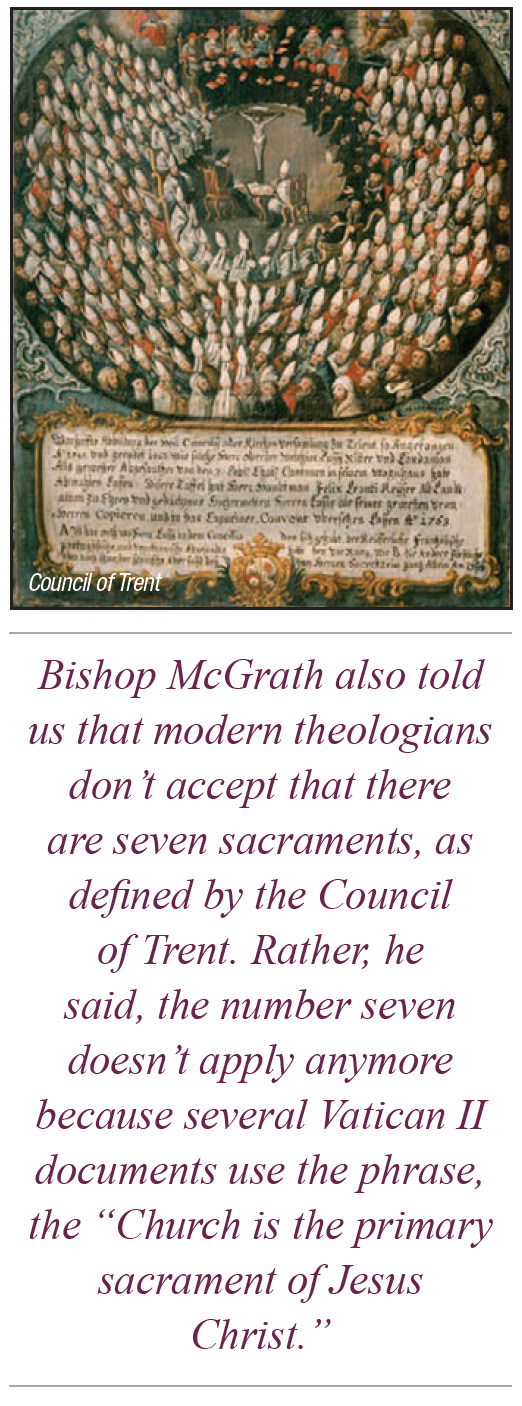
Bishop McGrath also taught us that modern theologians don’t accept that there are seven sacraments, as defined by the Council of Trent. Rather, he said, the number seven doesn’t apply anymore because several Vatican II documents use the phrase, “The Church is the primary sacrament of Jesus Christ.”
Catechism of the Catholic Church Disagrees
When I checked the official Catechism of the Catholic Church [CCC], which was originally published in 1992, I found that the CCC does not agree with the modern theologians admired by Bishop McGrath. The following quotes with paragraph numbers are from the CCC.
1113 There are seven sacraments in the Church: Baptism, Confirmation or Chrismation, Eucharist, Penance, Anointing of the Sick, Holy Orders, and Matrimony.”
774 The seven sacraments are the signs and instruments by which the Holy Spirit spreads the grace of Christ the head throughout the Church, which is his Body. The Church, then, both contains and communicates the invisible grace she signifies. It is in this analogical sense that the Church is called a “sacrament.”
The Power-Hungry Hierarchical Priesthood Grabbed the Sacraments from Laity
Bishop McGrath often quoted and referred to two books that were required reading for the course: Sacramental Theology, a General Introduction by Franciscan Father Kenan B. Osborne (emeritus professor of systematic theology at the Franciscan Theological Union, part of the liberal and ecumenical Graduate Theological Union in Berkeley), and A New Look at the Sacraments by Father William J. Bausch, a parish priest with a long list of books related to parish life.


These two influential writers, one a modern theologian and the other a priest/writer with multiple awards from Catholic press organizations, teach that in the early days of the Church after Christ’s resurrection, communities of believers, who, they say, “constituted the Church,” celebrated the sacraments. But over time, alas, the sacraments became the property of a hierarchical priesthood that used them to “tease out grace.”
“No longer the property of the celebrating Christian community at large, the sacraments became the preserve of the sacred specialist who dispenses them,” writes Father Bausch.
According to these and other writers about the sacraments after Vatican II, the ordained priesthood was a late development that took away rights to celebrate the sacraments that belonged to all Catholics. Asserting that “a hierarchical priesthood” took away the celebration of the sacraments from the laity seems calculated to foster feelings of victimisation. Similar to how Catholics were taught to feel offended after Vatican II when Mass is celebrated by a priest facing the altar, claiming that the priest is being arrogant and rude to the congregation by turning his back to them.
In many cases, Catholics have been similarly taught to view the Church’s hierarchy as evil men who grasp at powers that belong to the laity. They seem not to be struck by the oddness of the idea that the Church was wrong about what was taught for 1960 odd years until modern theologians figured it all out.
Back to the Revised History of the Sacraments
In Father Osborne’s book on sacramental theology, he writes that, after World War I, a group of theologians, including the German Catholic theologian Karl Rahner, “approached the history of the sacrament of penance” and developed what he referred to as a “more balanced and clarified approach.” Their approach, Osborne claims, found no evidence for the existence of most of the sacraments in the early Church documents. Osborne writes, “[I]f there is no historical evidence for a sacrament beyond a certain date, how can such a sacrament be considered to be instituted by Christ?”
Osborne gives something of an answer to his own question when he writes, “long before the church had developed a ‘definition’ of sacrament, the church had been living the sacraments.” But curiously, Father Osborne continues to deny that Christ instituted the sacraments.
According to Father Osborne’s book, the idea of the Church as “primary sacrament” originated before Vatican II in the writings of Father Otto Semmelroth and Father Karl Rahner. Dominican theologian Father Edward Schillebeeckx added the idea that Jesus is a sacrament in his book, Christ, the Sacrament of the Encounter with God, which was widely read by theologians before the council. Father Osborne describes how the writings of Rahner and Schillebeeckx influenced the bishops at the council, so much so that “seven times explicitly and once equivalently, the documents state that the Church is to be considered as a basic sacrament.” Because the Vatican II documents nowhere refer to the formulation that Jesus is the primordial sacrament, Father Osborne writes, “we are then able to say that the Church as a sacrament is the ordinary teaching of the Magisterium from Vatican II onward, and that the understanding of Jesus as a sacrament remains a theological position and no more.”
The distinction he draws between the “ordinary teaching of the Magisterium” and a “theological position” was quite helpful, because it gave me a way to describe what I observed at the ILM, where the bishop and the other instructors taught many new things as official Church teachings that are merely theological positions.
Redefining Sacraments Is a Help to Ecumenism
Father Osborne’s book states that the new definition of the sacraments is especially desirable for making Catholic doctrine acceptable to Protestants: “the definition of the Church itself as a sacrament and especially of Jesus as the primordial sacrament helps to bind together word and sacrament in a way which Protestantism can find more acceptable. With Jesus as the primordial sacrament, the dominance of the word is evident....” [Emphasis: mine. Notice the attempt to downplay sacraments in comparison to scripture, which is meant by “the word,” in the last sentence in this quote.] True ecumenism teaches Catholic truth respectfully to others outside the true Faith, and it does not try to minimize the Faith to create an amalgam faith that includes beliefs more comfortable to non-Catholics.
In Christian Sacraments in a Postmodern World: A Theology for the Third Millennium, a later book by Father Osbourne that I read while researching this article, Father Osborne suggests we look at the world itself as a sacrament. According to a review in the Jesuit magazine America, Father Osborne suggests “that the ‘[believer] in God and in revelation’ must first understand ‘the world itself as a possible sacrament,’ that is, as the place where God enacts the divine purpose to save all people. Then the believer can begin to see that the church is a sacrament only because God is present there, revealing God’s own self to those who assemble, in all their concreteness and intersubjectivity, in response to ‘the prior act of a revealing God.’ The universality of the church comes from God’s universal saving love and presence, not from any absolute claims made by a finite church.”
Father Osborne is absolutely wrong to state that the Church is finite, because the Gospels clearly teach that the Church is the Body of Christ on this earth, guided by the Holy Spirit. But then, as I’ll show in the next section, Father Osborne, along with other theologians quoted by Bishop McGrath, and other ILM teachers, believes the Gospels are inspired fictions. To my mind, that belief allows a theologian to make any claim he or she wants, because the Scriptures can no longer be relied on as authoritative.
Words and Events in the Bible Are Sacred Fictions
To better understand some of the words chosen by Bishop McGrath and other teachers at the ILM, it helps to remember that the theologians quoted in the assigned books assume the Gospels aren’t literally true.
For example, Father Osborne writes that those who believe that Christ actually said the words in the Gospels and that the events recorded in the Gospels actually took place as they were written are “fundamentalists.”
However, according to Osborne’s definition, Vatican II’s apostolic constitution, Dei Verbum (Word of God), reads like a fundamentalist tract. Dei Verbum says definitively, “the Gospels ... are the principal witness for the life and teaching of the incarnate Word, our savior.” It goes on to say, “the Church has always and everywhere held and continues to hold that the four Gospels are of apostolic origin....” The Gospels, whose “historical character the Church unhesitatingly asserts, faithfully hand on what Jesus Christ, while living among men, really did and taught for their eternal salvation.” And Dei Verbum says that the Gospels always “told us the honest truth about Jesus.”

Many modern theologians claim the opposite, that the Gospels were written by communities of believers who reflected on what happened and created stories that illustrated what the communities wanted to express about “the Christ Event.” Space does not permit me to document the effects of these claims in detail.
But here is one example. In the early 2000s, I paged through a study version of the New American Bible in a bookstore and found it had footnotes by modern theologians. I was shocked to read one footnote claimed that Our Lady’s “Magnificat” was inserted by “the writer of the Gospel of Luke” of a song that was commonly sung by the community that wrote the “Luke Gospel.” The wording of the footnote is consistent with the current biblical critical approach that denies the traditional authorship of the Gospels. Why should we care about the New Testament in spite of it not being literally true? Because, they claim, tGospelspel are sacred fictions intended to tell us something the communities were inspired to tell us about God.
I want to echo Flannery O’Connor, who famously told Mary McCarthy that if the Eucharist is only a symbol, “to hell with it.”
If the Bible is only an inspired fiction, I say the hell with it.
Those of us who sing and pray the “Magnificat” find joy in being able to sing the perfect poem that Our Lady was inspired to sing. Soon after she learned from the Angel Gabriel that she would be the Mother of the Holy One of Israel, she went to visit her old cousin, Elizabeth, who had also conceived a holy child foretold by the Angel Gabriel, remarkable because she was after childbearing age. Elizabeth’s child, John, leapt in his mother’s womb at the sound of Mary’s greeting to her, because by the Holy Spirit he recognized Jesus as the Messiah in Mary’s womb. Mary, who was raised in the Temple and schooled in the Scriptures, knew the hymn of Hannah, another mother who conceived a child out in her old age. Although the words are different, Hannah’s hymn, like the Magnificat is a prayer of thanksgiving, and of praise to God for the way He lifts the humble and humbles the proud.
The modern Bible scholars’ point of view gives no such joy. The Visitation, according to them is just another story that may or may not have occurred. Why bother reading Scripture if it was written by committee?
Bishop McGrath also embraced this way of viewing the Gospels, as evidenced by his statements in an article that was published in the February 18, 2004, issue of the San Jose Mercury News—about the movie, “The Passion of the Christ.” Many criticized the movie as anti-Semitic because how it depicts the role of the Jewish leaders in the arrest and death of Christ.
The creators of the movie defended their portrayal of the dealings of the Jewish religious leaders with Jesus by explaining that they faithfully followed the Gospels. Of course those who objected to the movie ignored that, in the movie, both the heroes and villains were Jewish. Some of the Jewish leaders persecuted Jesus and sought His death. But Jesus was also Jewish. There is no logic in claims like that.
Bishop McGrath agreed with the criticism, and he published a rebuttal in the San Jose Mercury News claiming “the four gospels ... are not historical accounts of the historical events that they narrate.”
Bishop McGrath’s position was that the moviemakers should not have portrayed the role of the Jewish leaders in the crucifixion even if the portrayal stayed true to the Gospels. He seemed to imply that the “communities” who wrote the Gospels had an anti-Semitic agenda, and that is why they made up a story that portrayed the Jewish leaders as evil. I’m not the only one who saw the damage to the faith when such outrageous claims challenging the authenticity of the Bible are made. You can see Bishop McGrath’s remarks quoted unfavorably in the Oxford Review here.)
“Bishop Patrick McGrath of the Diocese of San Jose, Calif., went way overboard when he wrote the following in the San Jose Mercury News (Feb. 18): ‘While the primary source material of the film is attributed to the four gospels, these sacred books are not historical accounts of the historical events that they narrate. They are theological reflections upon the events….’ But if the Gospels are ‘not historical accounts of the historical events,’ then those books are not ‘sacred.’ They’re fairy tales.”
What the Church Forgot
In his class on penance, Bishop McGrath did not quote the Gospels, but he only said that “the Church knew from the beginning that it could forgive sins.” For McGrath, “the Church” was not guided by the Holy Spirit and the apostles were not headed by Peter and those who succeeded them, but instead the Church was formed by the “celebrating community” from which modern theologians claim all doctrine and Scripture arose.
There is another obvious contradiction here. It puzzles me how strongly the post-Vatican II Church promotes the reading of Scripture while it also teaches that the Gospels are inspired fictions. To my way of thinking, teaching people to disbelieve the accuracy of the Gospels is a faith-killer. It may be one of many reasons why so many have left the Church.

Theologians: Is Penance Relevant?
After reiterating that the “Church is the primary sacrament of Jesus Christ,” Bishop McGrath told us that, currently, the sacrament of penance is “not part of initiation rites” of “baptism, Eucharist, confirmation,” because baptism forgives all sin. He said that theologians are currently reevaluating the sacrament of penance to “see if sacraments relate to the needs of our time.”
The bishop then said that the early Church offered “baptism for the forgiveness of sins;” that baptism was the “sign of a reality: turning away, turning around, turning to;” and that “sin after Baptism wasn’t considered as a possibility.” From this, the bishop concluded, “the Church always knew it had the power to forgive sin,” and now the Church is more aware of the “variety of ways to forgive sin.”
“Post-Vatican II theological reflection,” McGrath said, “has brought forth the various forms of reconciliation.”
Where Did Penance Come From?
In answer to his own rhetorical question, “Where did penance come from?” Bishop McGrath, in line with Father Osborne’s book, went on to say that, in the beginning of the Church, all Christians were preparing for the parousia, the Second Coming of Christ, which was thought to be so imminent that no provision was made for sinning Christians.
Public penance, which was reserved only for those who had committed the grave sins of murder, adultery, or apostasy, developed when Christ’s Second Coming did not happen right away, because Christians who sinned after Baptism needed to be forgiven. But, said the bishop, ordinary people had no way to do penance after baptism for serious sins. He told us that for that reason, “private penance evolved,” where “the priest took the place of the community.” Penance then stopped being a one-time-only thing, and it became repeatable and part of the “official tradition.” Eventually, he claimed, “the matter and form of the sacrament became all important, less important than repentance.”
I have to disagree again here. Any well-catechized Catholic knows that forgiveness of sin in the Sacrament of Penance depends on the sinner’s repentance.
The Eucharistic Forgives Even Mortal Sin
For Bishop McGrath, the Eucharist is one valid form of reconciliation, even where grave sin is involved. “Look for the area of forgiveness of sin in the Eucharistic Prayer,” McGrath said, and then he quoted the parts of the Mass that are penitential. According to the bishop, the third-century Church Father, Origen, taught that “even grave sin could be forgiven” by the Eucharist.
“Because Eucharist celebrates the saving acts of Jesus,” Bishop McGrath said, “in connecting ourselves” to His saving acts, “we are forgiven.” There is “no mention of only venial sins being forgiven,” the bishop said. It was only after the Reformation that the “Council of Trent emphasized the sacrament of penance, and other forms were lost.”
Following Father Bausch’s book, the bishop continued, “It’s going to take a lot of catechesis to restore the idea of the Eucharist as a sacrament of reconciliation.” The sacrament of penance has become an intrusion. Reconciliation is a lifetime process. Before Vatican II, the “social relevance of the sacrament was gone,” the bishop said. “The Church says that we have to make penance available to children who ask for it, so that is the reason [why penance has to be included in training for communion.”
What the Catechism and Pope Saint John Paul II Taught
In contrast, the Catechism of the Catholic Church teaches:
1457 Children must go to the sacrament of Penance before receiving Holy Communion for the first time.
A footnote to CCC 1457 refers to Canon Law 914:
“Can. 914 It is primarily the duty of parents and those who take the place of parents, as well as the duty of pastors, to take care that children who have reached the use of reason are prepared properly and, after they have made sacramental confession, are refreshed with this divine food as soon as possible. [Emphasis added.]
Penance is Optional for Those Who Feel the Need
According to Bishop McGrath, the sacrament of penance is optional “for those who feel they ‘need’ the sacrament before they approach the Eucharist.” The CCC also does not state the Eucharist as a sacrament of reconciliation for grave sin. On the contrary:
1385 To respond to this invitation we must prepare ourselves for so great and so holy a moment. St. Paul urges us to examine our conscience: ‘Whoever, therefore, eats the bread or drinks the cup of the Lord in an unworthy manner will be guilty of profaning the body and blood of the Lord. Let a man examine himself, and so eat of the bread and drink of the cup. For any one who eats and drinks without discerning the body eats and drinks judgment upon himself.’ Anyone conscious of a grave sin must receive the sacrament of Reconciliation before coming to communion.
1415 Anyone who desires to receive Christ in Eucharistic communion must be in the state of grace. Anyone aware of having sinned mortally must not receive communion without having received absolution in the sacrament of penance.
Pope John Paul II also affirmed that the Church’s teaching on the sacrament of penance did not change after Vatican II. In his 2003 encyclical, Ecclesia de Eucharistia (The Church draws her life from the Eucharist), the pope wrote, “the Catechism of the Catholic Church rightly stipulates that ‘anyone conscious of a grave sin must receive the sacrament of Reconciliation before coming to communion.’ I therefore desire to reaffirm that in the Church there remains in force, now and in the future, the rule by which the Council of Trent gave concrete expression to the Apostle Paul’s stern warning when it affirmed that, in order to receive the Eucharist in a worthy manner, ‘one must first confess one’s sins, when one is aware of mortal sin.’”
In Conclusion: Erroneous Teachings on Penance and the Scriptures’ Validity Harm Average Catholics
As I hope this article convincingly proves, theological positions that often contradict official Church teachings are being taught as doctrine even by members of the Church’s hierarchy. These errors have confused and weakened the faith of the many Catholics. As I wrote at the start of this article, it is not my purpose to single out one Bishop or one diocese, but to illustrate how these erroneous teachings came to be more widespread than most traditional Catholics may realize. And if anyone who may have been taught these errors based on theological speculations comes to learn the truth by reading this article, I will give thanks to God.