Good Friday
Friday of Holy Week with Selected Illustrations By James Tissot, with Commentary by Dom Guéranger and Tissot

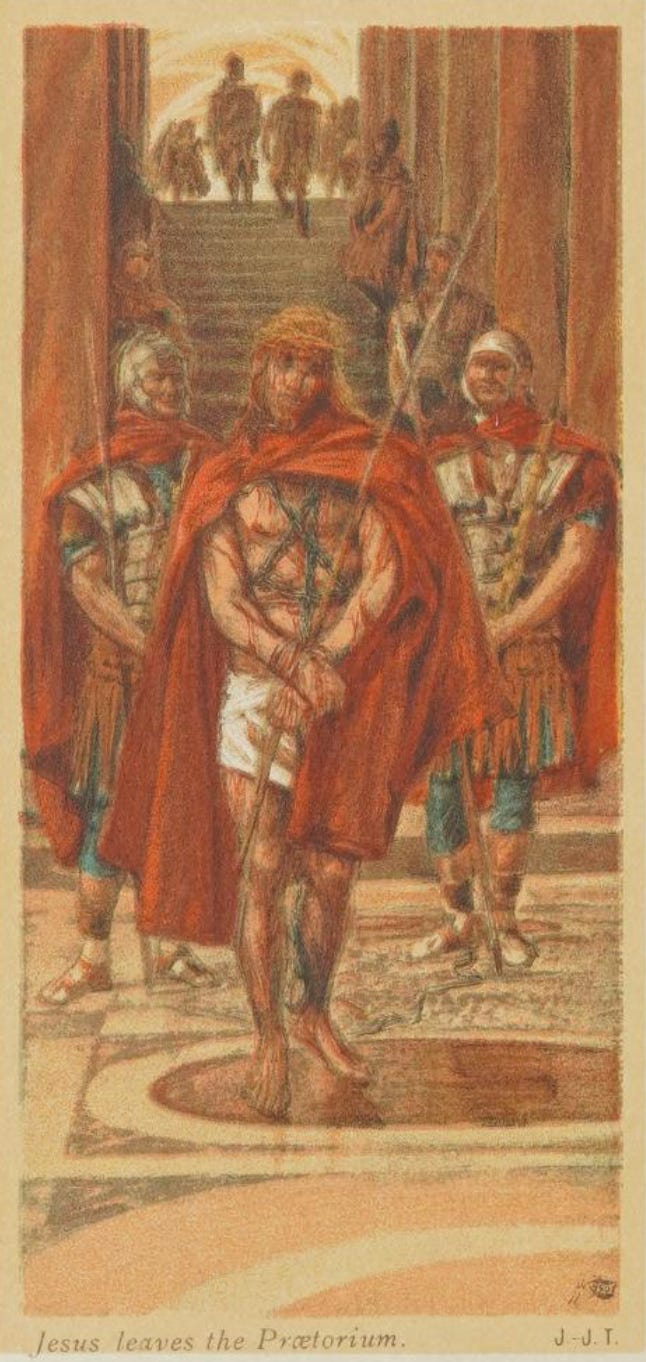
Selected illustrations for Good Friday
As Tissot wrote in his “Introduction to The Passion,” included here, he created illustrations for many many of the events of Christ’s passion that were not painted by others. The list of Tissot’s 52 major illustrations for Good Friday follows. It doesn’t include the 45 illustrations of events that happened between midnight and when Jesus began to carry His Cross on the Way of Sorrow, the Via Dolorosa. Limits of time and space make it impossible to include them all. The ones included are in bold. Again because of size limitations, this post does not include the bible verses or most of the commentary. Illustrations highlighted in green are linked to other sites that show the illustrations with some quotes from another translation than the Douay Rheims Bible that Tissot used.
The Via Dolorosa
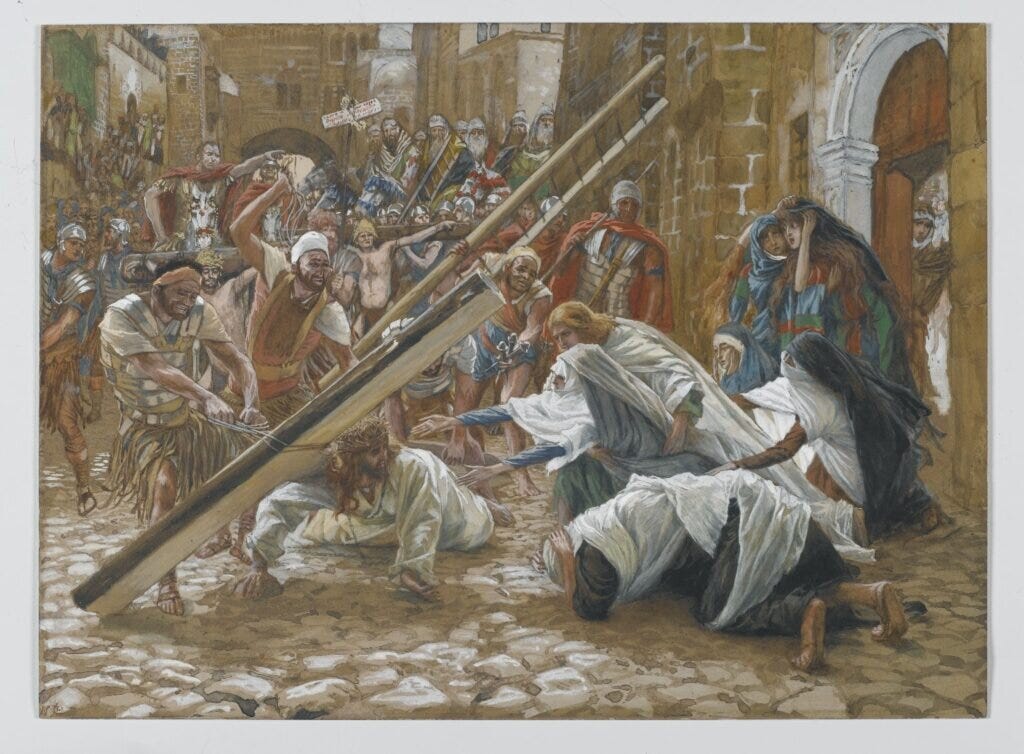
Jesus Falls Beneath His Cross
Jesus Meets His Mother
Tissot Commentary
The meeting of Jesus with His Mother ts not referred to in the Gospel narrative, but tradition is unanimous in asserting that it took place at the fourth Station of the Via Dolorosa. Mary was accompanied by Saint John, Mary Magdalene and Mary Salome, with other Holy Women, who, the Evangelists tell us, followed the Master to Calvary. It was very natural that the Mother of the Lord should have been present in the Forum at the scourging, though at a distance, and should have witnessed from afar the Ecce Homo incident; in fact, that she should have seen all that the rest of the crowd did. When the procession began to move off on its way to Golgotha, Mary, who had just heard the sentence of death passed upon her Son from the Gabbatha and who had seen the cross placed upon iis shoulders, tried to get near enough to Him to help Him with His burden, but it was impossibl=le, for the narrow street was already blocked up with soldiers and the crowds accompanying the Victim. The Virgin was, therefore, compelled to take another route and, after a most careful examination of the district, we feel able to assert pretty confidently which way she went. A tradition tells us that in the angle formed by the street leading to the Sheep-Gate and the Tyropoeon Valley, or Valley of the Cheese Merchants, there was a house with court-yards and out-buildings belonging to Caiaphas, who, as we know, had his Judgment Hall in the Sion quarter.
Now Saint John, as already stated above, had relations amongst the attendants of the High Priest, and it was thanks to this circumstance that he was able to go into the Judgment Hall and to secure the admittance of Saint Peter. He would thus also be able to let the Blessed Virgin and her companions pass through the courts and gardens of this house and, cutting diagonally across from one street to another, he managed for the little party of friends of the Master to arrive at the fourth Station of the Cross in time to meet Jesus without having to go up the steep ascent climbed by the procession. The locality speaks for itself in a remarkable way, and no one who has considered the matter on the spot, can fail to feel sure that the meeting between the Mother and Son took place on the spot indicated above and nowhere else. It ts generally supposed that the fall of Fesus occurred at the very moment of the touching meeting. This ts what Anne Catherine Emmerich says on the subject: ‘*Then one of the executioners asked of those standing by: Who is that woman lamenting so bitterly ? And some one replied: It is the Mother of the Galilean. Then the wretches loaded the unhappy Mother with insult and mockery, they pointed at her with ther fingers, and one of them took the nails which were to fasten Jesus to the Cross and struck Him with them, mocking Him before the eyes of the Blessed Virgin. As for her, she gazed upon Jesus and, overwhelmed with grief, was obliged to lean against the door to save herself from falling. She was as pale as death and her lips were livid.
Simon of Cyrene and his two sons Alexander and Rufus
Simon the Cyrenian Compelled to Bear the Cross
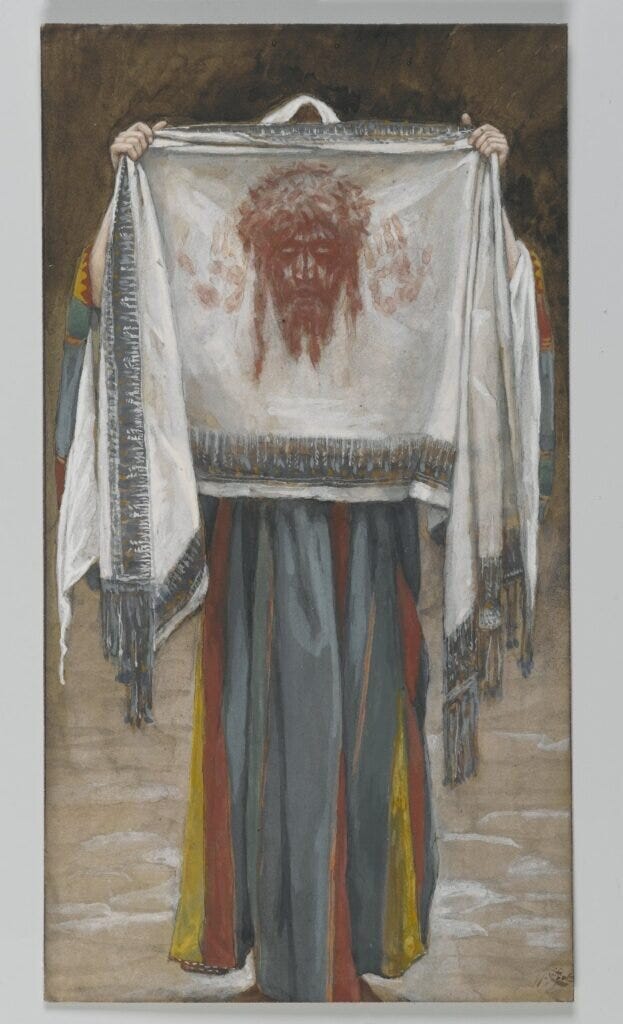
Saint Veronica
The Holy Face
Restoration of Calvary as Seen from the Walls of the Gate of Judgment
Calvary as Seen from the Walls of Herod’s Palace
The Procession Arriving at Calvary
The Holy Women Look on from Afar
Jesus Taken from the Old Cistern
Notes on the Sacrifices in the Temple
Jesus Stripped of His Raiment
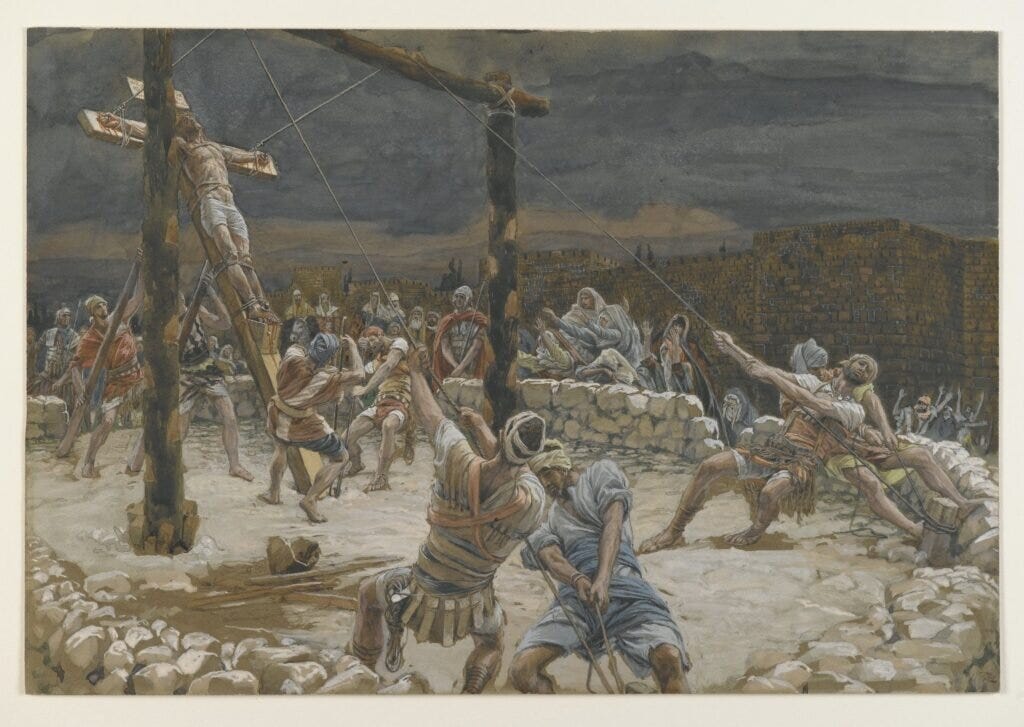
The Elevation of the Cross
The Pardon of the Penitent Thief
”They Parted His Raiment and Cast Lots”
"And Sitting Down They Watched Him There"
What Our Saviour Saw from the Cross
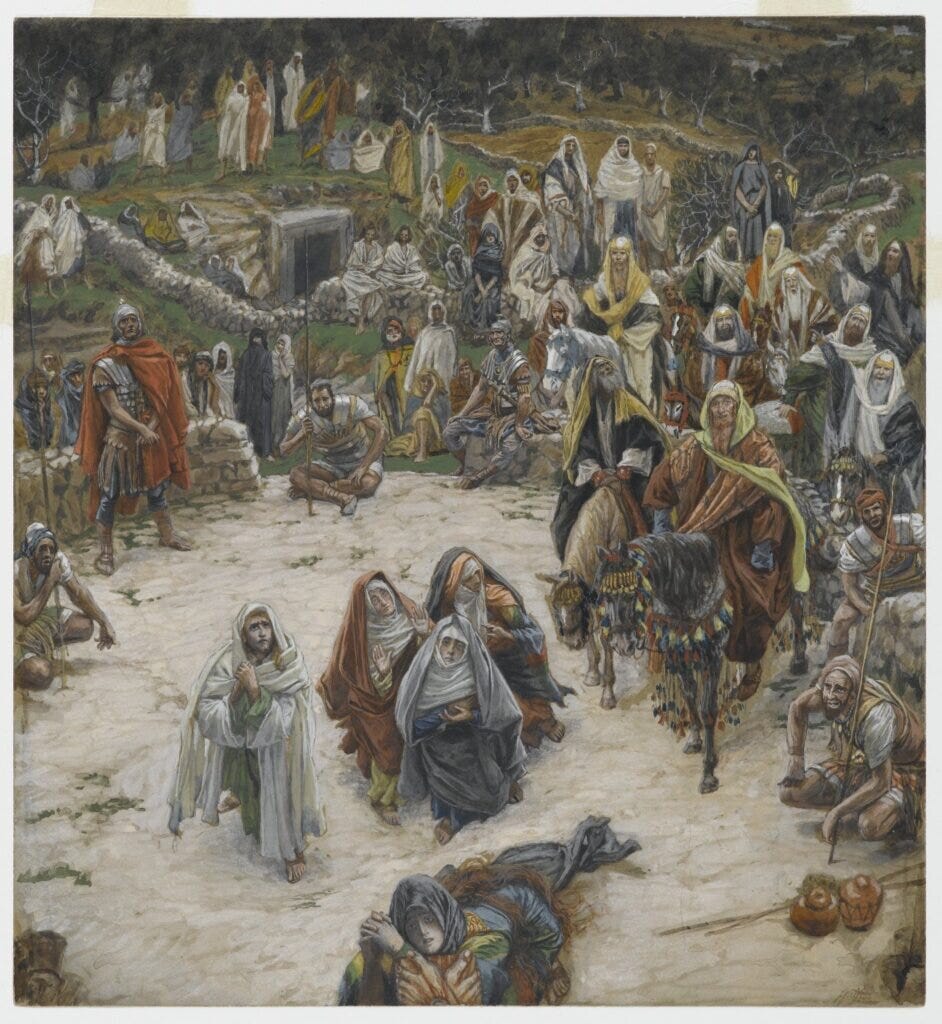
Stabat Mater
Mater Dolorosa
"Eloi! Eloi! Lama Sachtani!"
"I thirst!"
"It is finished!
"He Bowed His Head and Gave Up the Ghost"
The Crowd Leave Calvary
Chief Prophecies of the Death of Christ
The Earthquake
The Chasm in the Rock in the Rock of Calvary
The Centurion Glorifies God
The Centurion
Apparition of the Dead in the Temple
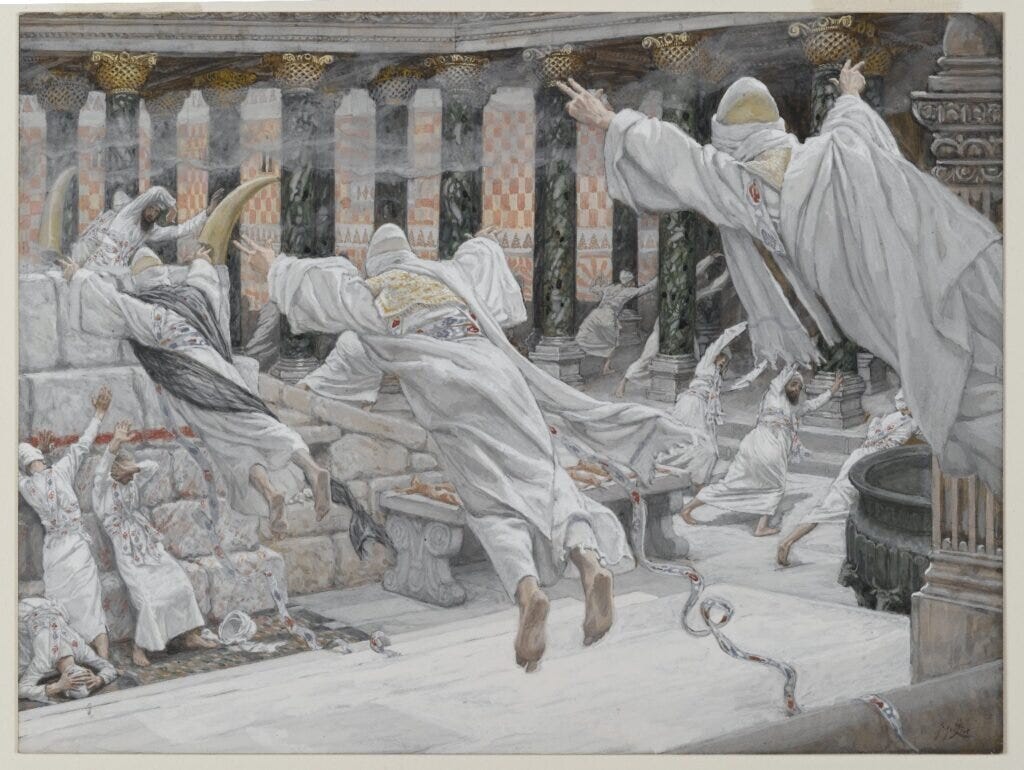
Apparition of the Dead in Jerusalem
The Soldiers Break the Legs of the Thieves
The Soul of the Penitent Thief
The Piercing of the Side of Jesus
The Confession of Saint Longinus
Jesus Alone on the Cross
Joseph of Arimathaea in Pilate’s House
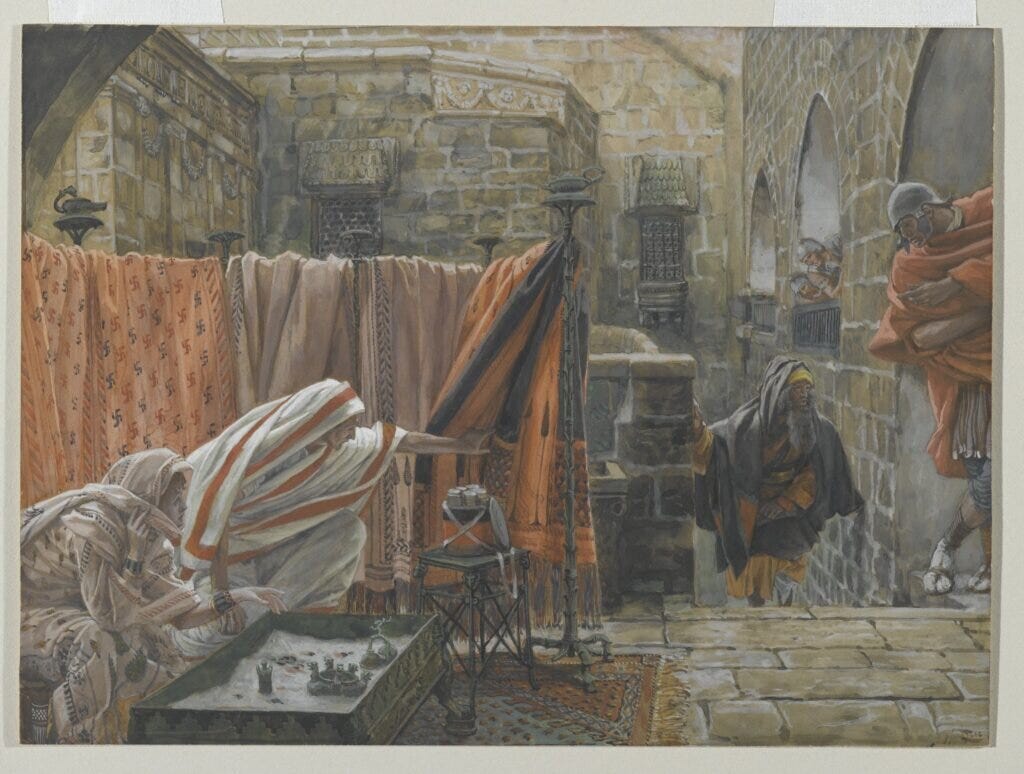
St. Mark 15: 43-45
Joseph of Arimathaea, an honourable counsellor, which also waited for the kingdom of God, came, and went in boldly unto Pilate, and craved the body of Jesus.
And Pilate marvelled if he were already dead: and calling unto him the centurion, he asked him whether he had been any while dead.
And when he knew it of the centurion, he gave the body to Joseph.
Tissot Commentary
Even Pilate must have been greatly troubled by the events of this terrible day. The dream of his wife Claudia, on which he has had time to think quietly since the iniquitous condemnation, the awful phenomena of which he has been a witness, and above all, his memory of the bearing of the Master, of His words so pregnant with meaning, of His look so calm yet so penetrating, with His superhuman silence later, all combine to fill with alarm the guilty conscience of the Governor, who has sacrificed an innocent Victim to fear for himself. All of a sudden, however, a member of the Sanhedrim comes to him. ‘went in boldly’, says Saint Mark, and truly courage was needed to proffer such a request as his! He came to crave as a favour that the body of the Victim should be given to him, thereby denouncing himself as a disciple of that Victim. His boldness was indeed something quite new in Joseph ‘the honourable counsellor’, for hitherto he had been, it is true, a disciple ‘but secretly for fear of the Jews’. It was Jesus on the Cross Who had changed him. He is no longer afraid of anything; he goes boldly to claim the body of the Master. And Pilate, full of marvel at so speedy a death, ‘called unto him the centurion’, to learn the truth from his mouth. The latter, as we know, himself full of emotion and excitement, told what he knew and withdrew, Joseph of Arimathaea then repeated his request and Pilate granted it without demur. Would not shewing a little benevolence now soothe his own conscience, full of remorse as it was for the crime of the morning? He therefore gave the body of Jesus to Joseph (donavit), says the Vulgate with precision. This free giving was by no means usual, for many a time did the procurators refuse to restore to their families the bodies of the dead unless they were paid to do so. Pilate, however. in this case is bent on being generous. He has no heart to make a bargain. Joseph of Arimathaea, therefore, leaves at once and disappears in the streets of the city to seek a shroud.
The Descent from the Cross
The Blessed Virgin Receives the Body of Jesus
The Body of Jesus (Carried to the Stone of Anointing)
The Stone of Anointing
The Holy Virgin Kisses the Face of Jesus Before It is Wrapped in the Winding-sheet
Christ Carried to the Tomb
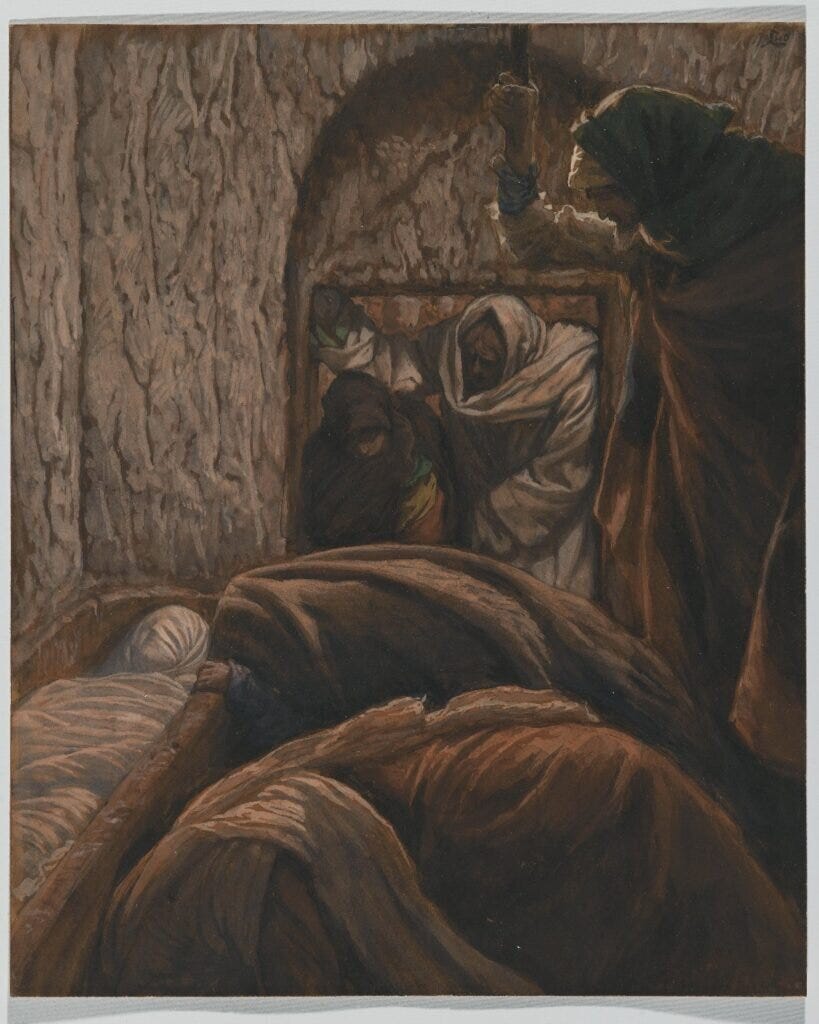
Christ in the Tomb