Peace in the City
A historic monastery of Carmelite nuns in Santa Clara, California, is an oasis of prayer in a busy city neighborhood

More things are wrought by prayer
Than this world dreams of.
—Alfred Lord Tennyson
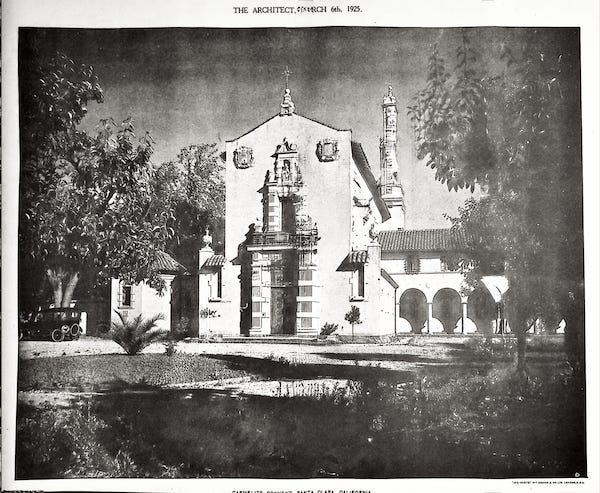
For 109 years, the Carmelite Monastery of the Infant Jesus has been a Santa Clara, California, landmark. The gardens are expansive, beautiful, and peaceful. The design for the chapel won a prestigious award at the 1925 Paris exposition, and the land on which the monastery stands is connected not only to the history of Catholic California but also to author Jack London and his famous novel, The Call of the Wild.
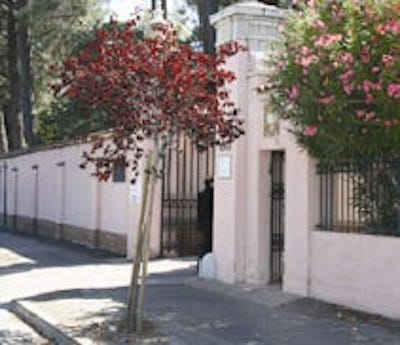
Dusty pink stucco walls topped with wrought-iron railings may be entered by the public during limited hours through tall, ornamental, wrought-iron gates. The walls surround eleven acres of monastery grounds at the corner of Lincoln and Benton Streets.
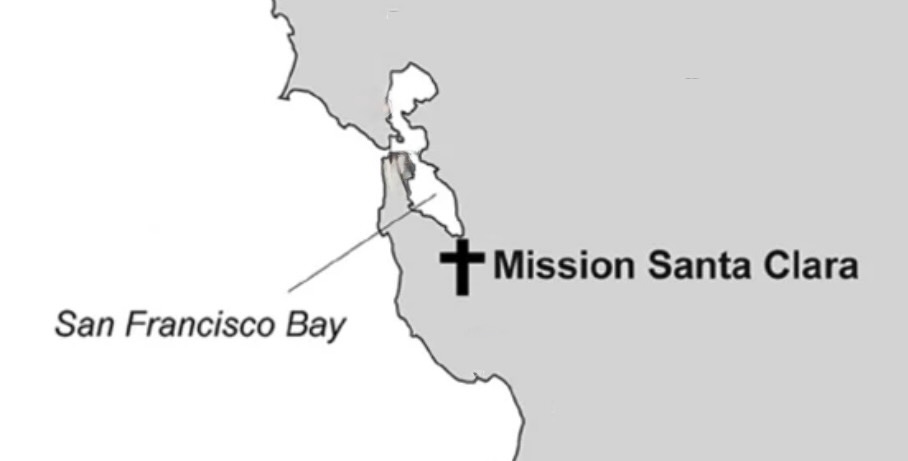
It’s a place set apart and seemingly outside of time, in a densely populated neighborhood of private houses and small strip malls near Santa Clara’s old business district. The monastery is located less than a mile from the site of the Mission Santa Clara church, which currently serves as the chapel for Santa Clara University. The city, the county, and the university get their name from the Mission Santa Clara de Asis, which was founded by Franciscan monks and once took up 80,000 acres at the southern end of San Francisco Bay, forty miles southeast of San Francisco. That was the first California mission to be named for a woman saint, Saint Clare of Assisi, who was an early follower of St. Francis of Assisi and the foundress of the Poor Clares.
The Bells and the Garden
Four chapel bells that were baptized on July 17, 1917, and given the names of “Jesus,” “Maria,” “Joseph,” and “The Angels,” regularly toll from behind the walls. The consecration of bells is informally referred to as a “baptism,” because they are blessed with holy water and given names. Here’s an excerpt from the prayers for the ceremony from the Roman Ritual that shows why the bells are blessed: not only to call people to worship, but to strengthen faith, to drive away evil spirits and bad weather, and summon angels to watch over those who worship in the church where the bells are rung:
Let the people’s faith and piety wax stronger whenever they hear its melodious peals. At its sound let all evil spirits be driven afar; let thunder and lightning, hail and storm be banished; let the power of your hand put down the evil powers of the air, causing them to tremble at the sound of this bell, and to flee at the sight of the holy cross engraved thereon … when the peal of this bell resounds in the clouds may a legion of angels stand watch over the assembly of your Church, the first-fruits of the faithful, and afford your ever-abiding protection to them in body and spirit.
The Carmelite nuns1 who live there occasionally receive complaints about the “noise” of the bells from some, who seemingly don’t appreciate the protection offered by the bells and the loving prayers emanating from the cloister2.
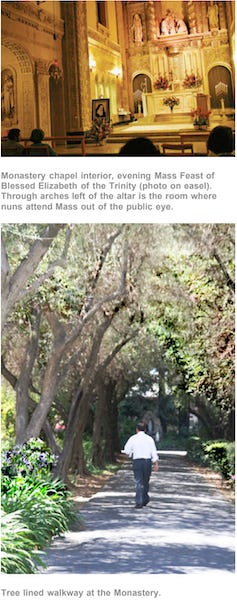
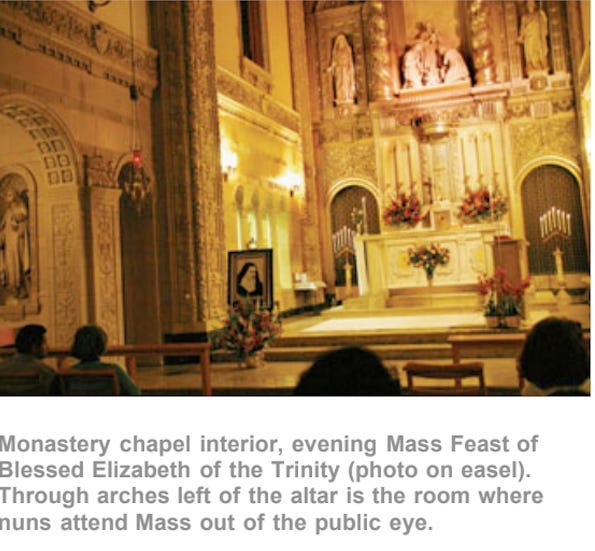
Daily Masses at the chapel are open to the community; the nuns attend in a separate room on the left side of the altar, behind a screen.
Most of the religious women at this Carmel have virtually no contact with the outside world. They wear habits and eat a restricted diet. Silent prayer and worship are the center of their vocation, and they pray for all those who ask for their prayers.
During the hours the monastery grounds are open to the public, visitors can enter what feels like a secret garden. To the right of the narrow main drive is a large olive grove reminiscent of the Garden of Gethsemane. The exquisite Spanish Renaissance-style chapel is in the center of the public area and connects to the private quarters of the nuns. A rose arbor, many flowers, and a wide variety of plants line brick pathways.
The garden that is open to the public is the “outside garden”; much of the property is reserved for the private use of the nuns and is separated by an interior wall. Mostly hidden from the city around them, the nuns preserve a contemplative life that is in sharp contrast with the light-speed pace of Silicon Valley life.
The nuns are members of the Catholic religious Order of Discalced Carmelites, which was founded in Spain by St. Teresa of Avila, a reformer of the original Carmelite order, which began on Mount Carmel in Israel. Discalced means “shoeless” and refers to the fact that members wear sandals instead of shoes, as part of the reformed order’s revived emphasis on penance and poverty. The Carmelite order is dedicated to a life of prayer.
Roots of the Carmelite Order
From reading a document by Louis of St. Teresa, O.C.D., in the 17th century, and from reports about the contents of papal bulls and other early documents about the order, I discovered some early traditions about the origins of the order.
Carmelites traditionally believed that Elijah’s followers, called the School of the Prophets, built the first chapel in honor of Our Lady at the Spring of Elijah, immediately after Elijah’s vision of the little cloud and his prophetic understanding that the cloud symbolized the future coming of Our Lady as the Immaculate Conception, the immaculate mother of Our Savior who would be conceived without original sin and bring salvation to the world. Some wrote there were Schools of the Prophets on Mount Carmel and at other places in Israel as far back as the time of the prophet Samuel.
It was believed that a line of hermits in the style of Elijah’s prophets continued to live in unbroken succession on Mount Carmel until the birth of Mary and the coming of the Savior that she would conceive by the Holy Spirit and bring into the world.
It was also believed that the Virgin Mary visited there as a child with her parents, and that St. Joseph lived there for a time after he was chosen to be the husband of Our Lady.
“One beautiful passage from a private revelation to a mystic relates that after the High Priest of Jerusalem had announced that St. Joseph was to be the husband of Our Lady selected by Our Lord Himself, ‘the young man from Bethlehem joined the hermits of Elias on Mount Carmel and continued to pray fervently for the Messias3.”
It was said that the Holy Family stopped on Mount Carmel on the way back from Egypt, and that Christ brought his disciples there often (it’s not far from Nazareth).
After Christ’s death and Resurrection, Our Lady was supposed to have brought a group of virgins to live at Elijah’s Spring. The Jewish hermits were said to have become Christians. They survived many waves of persecution from the Muslims in the following years until they were wiped out before the time of the Crusades. However, at least one source I read said that the Europeans hermits found an existing Byzantine church dedicated to Our Lady when they arrived. Current official Carmelite documents are silent about these traditions.
During a time when religious orders were being weeded out by Rome, these Carmelite origin stories were much disputed by competing orders, so much so that the current pope was forced to intervene and shut down the argument. The traditions were never condemned as false; only the violent disagreements about them were silenced.
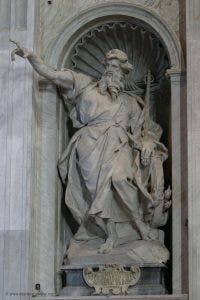
In June of 1725, Pope Benedict XIII permitted the Carmelites to place the statue of Prophet Elijah in the Vatican Basilica with the pedestal inscription “Universus Ordo Carmelitarum Fundatori suo S. Eliae Prophetae erexit” (The entire Carmelite Order erected the statue to its Founder). Through this act, the Order affirmed the tradition that the Carmelites are the direct descendants of Elijah based on the uninterrupted succession from the time of the Prophet onwards.
Why Are Traditions Like These Discarded?
A tenet of belief among many modern scholars is that only written sources can be trusted, and they tend to discount anything from the past if they can’t find documented evidence. One objection to that approach to history is that many things that have been written down have later decayed or otherwise been lost in the ensuing centuries. Another objection is that even if something was never written down, it is an indubitable reality that events, stories, values, and beliefs have been memorized and reliably handed down from one generation to the next by oral tradition, in cultures all around the world. The documents-only approach to determining historicity ignores the validity and accuracy of oral tradition, which brought us the works of Homer, just to give one major example.
What Is Still Part of the Official Carmelite History
What is well documented and still part of the official Carmelite history is that during the time of the Crusades, after the Holy Land was made temporarily safe for Christians for a short number of years, European pilgrims seeking to live a penitential life settled at Elijah’s spring and became Carmelites. Significantly for the O.C.D.S. identity, these first clearly recognized Carmelites were lay people, too. As the book Carmel in the Holy Land states about the first hermits, “They formed a group not yet within an established monastic structure, coming together spontaneously to ‘do penance’ … to dedicate themselves to a life of prayer and asceticism.”
They requested and obtained a rule of life from St. Albert, the Patriarch of Jerusalem. When the Muslims began recapturing the Holy Land again, many of the Carmelite monks fled to Europe. Those who stayed were massacred in 1291 in the Wadi ‘ain es-Siah, which is called in English “the valley of martyrs.” Archeologists have unearthed the ruins of a 14th-century monastery and a chapel to Our Lady, possibly from the 4th century there.
As is true for many religious communities, after religious life and worship changed after the Second Vatican Council of the Catholic Church, the number of nuns has shrunk. Few new nuns have joined, while existing nuns have aged. Today, a small group of six nuns lives sequestered in the monastery of the Carmel4 of the Infant Jesus.
Carmelite Saints
Carmelites cultivate humility, but there is a quiet pride about the prominence of many Carmelite saints, including St. Teresa’s fellow reformer of the Carmelite Order, St. John of the Cross. St. John of the Cross and St. Teresa are famous in Spain and around the world for their mystical writings, and the theological excellence of their writings brought them the honor of being named Doctors of the Catholic Church.
A French Carmelite, St. Therese of Lisieux, who is also called the Little Flower, is another Doctor of the Church.
Yet another Carmelite Teresa, St. Teresa Benedicta of the Cross, who was a philosopher named Edith Stein, before she was a Carmelite, and she might someday join the other Teresa and Therese as the third woman Carmelite honored as a Doctor of the Catholic Church.
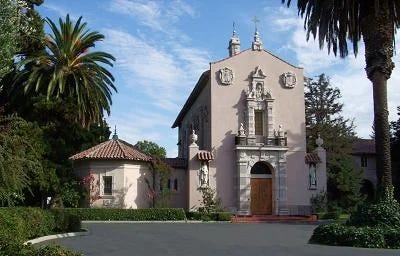
In a niche on the facade to the right of the chapel’s entrance stands Elijah, whose school of prophets on Mount Carmel in the time of ancient Israel preceded the earliest European Carmelite hermits who settled there during the Crusades. Above the entrance in another niche is the Virgin Mary, who is honored as the “Queen Beauty of Carmel,” holding the Infant Jesus.
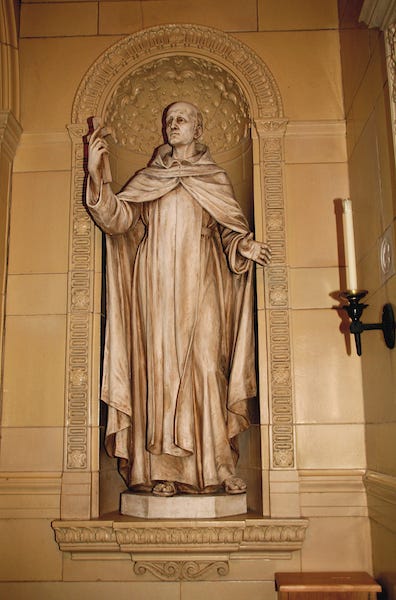
Inside the chapel, Saints Teresa of Avila and John of the Cross flank the sanctuary at the ends of the side aisles. A statue of the Little Flower reclines under an altar in a side chapel at the left front.
Benefactors and Designer of the Monastery
In 1908, Alice Phelan Sullivan, a member of a San Francisco pioneer family, endowed the first California foundation of Carmelite nuns in that city. (No, I’m not related to wealthy and religious California pioneer Sullivans—lovely as that would be). Alice’s daughter Ada first went East to join the Discalced Carmelites in Boston and took Agnes as her religious name, eventually becoming Mother Agnes, prioress of the Santa Clara Carmel.
When the San Francisco foundation outgrew its temporary home in 1914, Mother Agnes’ brother, Noel, was one of the purchasers of the Santa Clara site for the current monastery. The other purchaser was Senator James Phelan, Alice Sullivan’s brother and uncle to Noel and Mother Agnes.
They selected the site partly because its proximity to the Jesuit University of Santa Clara would ensure the availability of priests to say Mass and hear Confessions.
The Monastery Chapel was designed by the distinguished church architect Charles D. Maginnis. His firm Maginnis Walsh also designed the Basilica of the National Shrine of the Immaculate Conception in Washington, D.C., and the collegiate Gothic Gasson Hall at Boston College—which received praise from influential American proponent of Gothic architecture, Ralph Adams Cram in 1909.
In 1925, the chapel’s architecture received both the Gold Medal of Excellence from the American Institute of Architects in Boston and the prestigious International Grand Prix at the Paris exposition. It is considered to be the most perfect example of Spanish Renaissance Ecclesiastical architecture in the New World.
In a memorial chapel at the back, Alice Sullivan is buried along with her daughter, Mother Agnes, and son, Noel.
Historical Connections
The eleven acres were part of a 95-acre estate owned by William Lent in 1856, who built a mansion there. In 1866, for $48,500, James P. Pierce purchased 88 acres, along with Lent’s mansion, and Pierce named the place New Park after his grandfather’s country home in England.
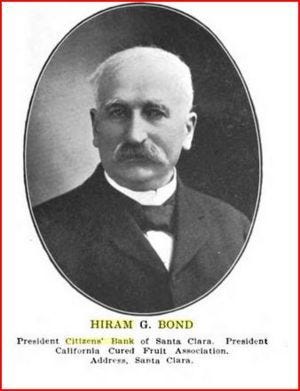
Judge Hiram G. Bond had bought New Park for $25,000 in 1895, and he sold the estate in 1906. A portion of this estate was subdivided into the “New Park Subdivision” in 1908, and 5 years later, the mansion on 11 acres of gardens, orchards, and vineyards became the first permanent home of the Carmelite Order in California.
Literary Significance
The site has a lot of literary interest for another reason as well; it was once part of New Park, a hangout of writer Jack London, who stayed with his friends, the Bond brothers, there when the ranch was owned by Judge Hiram Bond. Jack London used the ranch for the opening scene of his classic Call of the Wild. The dog, Buck, who was stolen from the ranch in the book, was patterned after a dog owned by Marshall Bond.
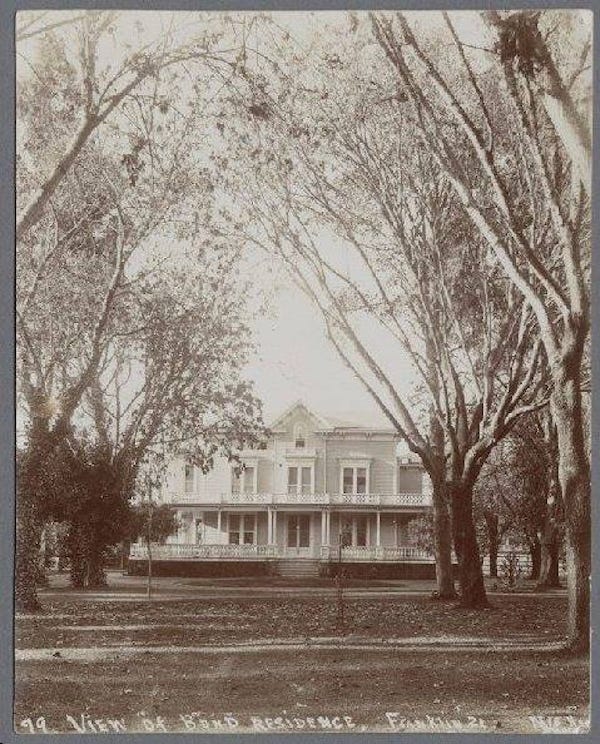
London had met the Bonds while prospecting for gold in Alaska. London affirmed that Buck was one of the Bond brothers’ dogs by signing the following photo.

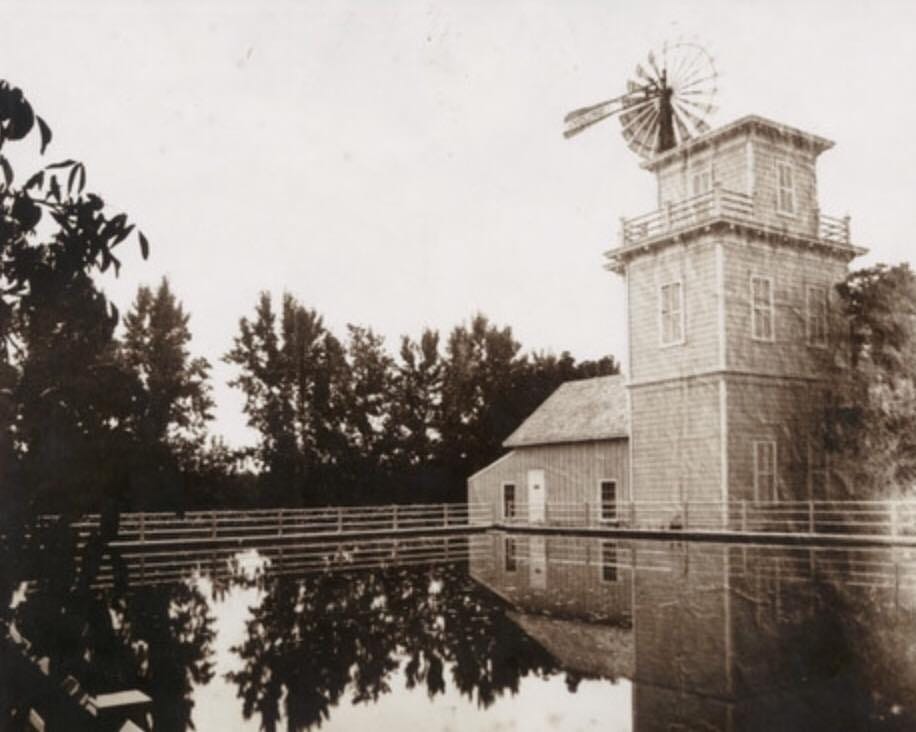
A carriage house at the north end of the property and a water tower, both survive from Judge Bond’s time. London is said to have been fond of swimming in the spring-fed pool near the water tower, which has since been filled.
My Personal Experience of the Carmel
For six years, I attended meetings of a secular Carmelite group in the remodeled carriage house, while I was discerning whether to make final promises, and I treasured my monthly visits to the monastery grounds.
Carmelite aspirations were inherited in my case. My mother had been a Catholic convert and entered the Carmelite convent in Cleveland as a postulant. She left after she and the superior decided she needed a more active vocation. As it turned out, she later met my father, had two daughters, and another daughter was on the way when my father died, and she was left to raise the three of us on her own. I’d call that an active vocation.
My mother gave me the middle name Therese after the Little Flower, but she told me she was also honoring the Big Teresa, the founder of the Discalced Carmelites.
When it came time to make final promises, I decided not to make the lifetime commitment to the group. Part of my reasoning is that the secular Carmelites are to pray Morning and Evening Prayer and, optionally, Night Prayer, and to go to daily Mass if possible. I was not keeping up to my own satisfaction, and I wished the spiritual advisor cared more that I wasn’t strictly observant. My thinking was along the lines of Groucho Marx’s famous quip, "I refuse to join any club that would have me as a member.”
I thought their screening of secular candidates should be as strict as that of candidates for the cloistered life. So I essentially screened myself.
Another obstacle was that sometime during my discernment period, I had started attending traditional Latin Masses and singing in a choir that sang traditional Gregorian chant and polyphony. The new Mass seemed more and more perfunctory to me, although I don’t deny it is valid. The more I learned about the official Church documents about sacred music, the more I disliked the modern hymns I could hear the nuns singing with their sweet voices from their enclosure during Masses. According to authoritative Roman Catholic Church documents on liturgy from before, during, and after the Second Vatican Council, the Church has never stopped wanting us to sing sacred texts that are part of each day's Mass.
You might be interested in this article, in which I go into the details of what is wrong about what is sung at most Masses since the Second Vatican Council.

I daydreamed that if I could find a group of Carmelites that worshipped at the traditional Latin Mass, sang the Mass texts of the day instead of random hymns, and prayed the Divine Office, I would join them if they would have me. I was happy when a new foundation of Carmelites split off from a thriving traditional foundation in Nebraska, and came to the northern San Francisco Bay Area, and a lot of their Masses celebrated by visiting priests were traditional. But after Pope Francis released Traditionis Custodes, restricting the Traditional Latin Mass, the nuns in the new foundation had a visitation from the Vatican, and they were discouraged from their traditional practices. They didn’t have a secular group that met there, anyway, and it would take more than an hour each way to get there for meetings.
This article is a greatly expanded and rewritten from “Peace in the City,” an earlier article I wrote in 2007 for Santa Clara Weekly.
Want to read some more about Carmelites and Mount Carmel? These three blog posts at Dappled Things are about a pilgrimage with a Carmelite priest and several secular members to Mount Carmel, where the order began.
History of the Santa Clara Carmelite Monastery from 1922
More details for those who might like to take a deeper dive into the details of the monastery’s founding. Excerpted from History of Santa Clara County, California, by Sawyer, Eugene T. Published 1922, by Los Angeles: Historic Record Co.
“Decidedly among the most interesting of all Roman Catholic institutions of faithful, unremitting activity and wide, permanent influence for good in California is the Carmelite Monastery of Santa Clara, where the nuns, leading a secluded life, pinning their faith to the precept also voiced by Shakespeare, “More things are wrought by prayer than this world knows of5” pursue a routine of industry and severity, and yet enjoy a sublimely happy, supremely blissful existence comparable, perhaps, only to the heaven they contemplate from afar. The name Carmelite is derived from Mount Carmel, a Palestine mountain, famed in song and story, the sanctified abode of the prophet Elias.
“. . . The Carmelites, embracing friars, nuns and religious and secular tertiaries, form one of the four great mendicant orders of the Roman Catholic Church. The first written rule of the Carmelites was given, A. D. 400, by John, Forty-fourth Patriarch of Jerusalem, and in 1251, at Cambridge, England, Our Blessed Lady revealed to St. Simon Stock that those who died invested with the Carmelite scapular will be preserved from eternal fire.
“Since then, this scapular, or habit of the Carmelites, has had a wondrous history, as wide as the world, and through it the faithful participate in all the good works, prayers and penances offered by the religious. Following St. Teresa, justly called “the glory” of Spain and the Church, the Carmelite sons and daughters, have extended the benefits of the order to the farthest parts of the earth, and never have they allowed trials to daunt their courage or quench the ardor of their charity.
“A discalced Carmelite, Father Andrew of the Assumption, offered the first Mass in California, on November 10, 1602. In that year, Don Sebastian Viscayno, having been sent to explore the Coast line of the Californias, was accompanied by two Carmelites: yet there was no foundation of Carmel in this state until 1908.
“In 1619, some thirty years after the death of St. Teresa, Lady Mary Lovell, daughter of Lord Roper, founded a Carmelite convent in Antwerp for English-speaking ladies. In 1790 Bishop John Carroll of Baltimore, brother of Charles Carroll, of Carrollton, the signer of the Declaration of Independence, invited the Carmelites to his vast diocese, just after the Revolutionary War.
“In 1863 the nuns from Baltimore Carmel founded the monastery at St. Louis; and during the great Catholic Congress at Baltimore in 1889, the Boston delegates learned of the esteem in which the Carmelites were held in that city, and devout Boston Catholics wishing to have a house of Mount Carmel, the wish was approved by the Archbishop of Boston, and five nuns, appointed by Cardinal Gibbons, went to the hub of New England, each there, amid the bustle of materialistic life, to dwell in her cloister, daily present petitions for remote souls, preparing her own soul, in order to make her prayers the more effective, by penances, by perpetual abstinence, by almost continual fasting, by sleeping on straw, wearing coarse woolen, and by many other exercises of constant mortification. In 1897 appeared a volume, now out of print, called “Carmel; It’s History and Spirit; compiled from approved sources by the Discalced Carmelites of Boston,” and designed to give information as to the meaning of the fourth Carmelite monastery in the United States and the first in New England; and therein was sketched the history of the ancient mount in Palestine, the progress of the movement through the Greek and Latin eras, the inspiring story of St. Teresa and the great reform she wrought, the extension of the order to other countries and the crossing of the Pyrenees, the rise of the English Teresians and the going forth of their American sisters, with an insight into the spirit and rule of Carmel, and her devotions.
“The laying of the cornerstone of the Monastery of the Infant Jesus for the Carmelite Nuns of Santa Clara took place on Gaudete Sunday, December 17, 1916, when the Most Reverend Archbishop Hanna performed the ceremony, accompanied by many priests and representative laymen, Knights of Columbus, and throngs of people. The sermon, a wonderful discourse on “Wisdom hath built herself a house,” was preached by the Very Rev. R. A. Gleason, S. J. Provincial; the University of Santa Clara offered hospitality to the visiting clergymen, and everything was done to make the occasion a memorable one in the annals of the historic town of Santa Clara.
“On November 1, 1906, Mrs. Alice Phelan Sullivan, since deceased — the beautiful and royal daughter of the church in whose honor the chapel and monastery will forever stand as a memorial — accompanied by her son and daughter, arrived at the Carmelite Monastery, Mt. Pleasant Avenue, Boston, and there her child made the sublime sacrifice of all the world calls dear and entered the austere walls of Carmel. Some time after, the Most Reverend Archbishop Riordan, going on his ad limina to Rome, calling to see the former member of his diocese, was favorably impressed with all that he saw of the Monastery, and this led Mrs. Sullivan later on to request His Grace to admit the Nuns to his Archdiocese. He hesitated, however, for the earthquake and fire had wrought many ravages in church and convent, and it seemed no time for new endeavor; but when Mrs. Sullivan offered to assume the responsibility of foundress, and when it was made clear that the nuns, far from fearing conditions, only felt in them an added spur to prayer and a longing to aid in some way in the upbuilding of the glorious city for a time laid low, he yielded and wrote the invitation that brought a little colony 3,000 miles across the continent to settle in San Francisco.
“Archbishop Riordan himself said the Foundation Mass on October 4. The chapel was beautifully appointed, the altar and pews and organ in place, the “Turn” grating and partitions so arranged that when the three days set aside by the Archbishop for visitors were at an end, the nuns could very soon resume their regular life. Being so strictly cloistered, it had been considered wise to permit them to meet the public in order that prejudice might be removed and friends be made for the newcomers, and indeed the event proved the wisdom of the permission, for the annals of Carmel record an unprecedented welcome from the Catholic body of San Francisco. Carmel ranks in the church as a mendicant Order, and cherishes poverty as a glory and a crown — a fact the more interesting for so many who enter its severely plain walls come from homes of wealth.
“While accepting with profound gratitude the grounds and monastery donated in memory of their foundress, the nuns have from the beginning refused endowment, and true to the ancient traditions of their order, cast themselves upon the charity of the faithful for their daily support. They came in absolute poverty, for, though the monastery in Boston offered, as is customary, the dowers of the nuns who were to go, they pleaded to be allowed to leave all behind and to trust themselves to God, and the charity of those who were to receive them, and they never had cause to regret their step. During the first days before their manner of life was known, Mr. and Mrs. Sullivan and Miss Phelan and members of the family, took turns day by day and brought with their own hands the alms of fish, vegetables and groceries, upon which the Sisters lived. Soon others learned the mysteries of the receiving “Turn,” and the provisor of the Convent had wherewith to supply the daily menage.
“When the five nuns came from Boston to found the Carmelite Monastery in San Francisco, the premises once occupied by Robert Louis Stevenson were used for a while; and experiencing the need of more room, they bought eleven acres on Lincoln Avenue, in Santa Clara, upon which they built the monastery chapel, and the monastery, designed by the celebrated architect, Charles D. Maginnis. This chapel contains the burial place of Mrs. Sullivan, who founded the Monastery here. A book might be written about this wonderful group of the Carmelite Monastery at Santa Clara which not so long ago led “The Architect,” one of the best of art journals, to say: “Of those who spin along the smooth high- way through the orchards of the pleasant country between San Jose and San Francisco, how many know that a park of stately trees on the outskirts of Santa Clara secludes a building which in Europe they would gladly incur discomfort and expense to visit, and is theirs to see for the mere stopping?”
“In essential scheme, as “The Architect” has put it, the Carmelite Monastery Building (designed by Maginnis & Walsh) is a rectangular arcaded cloister, surrounded on three sides by two-story buildings, with the public chapel projecting from one corner, the whole structure slipping quietly and naturally into its place among the trees like a thing which has always been. Italian or Spanish, unmistakably Mediterranean, the architecture is one with the broad, sunny Valley of Santa Clara. The dominant character of the building is adequacy, or poise. The richness never relapses into mere lavish display, but assures a prevailing note of simplicity and restraint.
“The exterior walls are plaster of a pinkish buff tone.All ornament is of buff terra cotta, lighter and less pink in tone. The roofs are tile in slightly varying shades of red. These colors are ideal foils to the green of the California foliage and the blue of the California sky; and throughout the rainless seasons of the year they must enter into happy combination with the tawny brown of the dry grass covering the ground. The similar interior cloister has pavements of dull red brick. On the interior, the most noteworthy room is the Nuns’ Choir, behind the chapel and connected therewith by metal grilles, through which the nuns can hear the services unseen. The barrel vault and penetrations are of white plaster, the walls of face brick of buff hues, varied by pale tones of greenish and lemon yellow, the pavement of dull red brick, and the wood of benches and altar is gum in its rich natural color. The public chapel is of cream plaster, light buff terra cotta, with dull red brick pavement and open ceiling of wood in its natural color or but slightly mellowed by stain. The richly-designed carved wood altar end is finished with a soft metallic luster, a quasi-iridescent sheen. Separated by bronze grilles from the east aisle of the chapel are the small Lady Chapel and the Mortuary Chapel, the latter a memorial to the donor of the building. Here are a scale and finish more jewel-like, precious marble covering walls and floors, altars and appointments of detailed perfection, and gilded plaster vaults. The Building Review considers that the architects have been very successful in their unique and delicate expression of a domesticity presented by this community of women, whose lives are wholly consecrated to religion, in a cloistered order of an unusual austerity of habit, where hours not devoted to domestic duty are given to prayer, contemplation and spiritual exercises; and speaks in particular of the relation of the community to the public, and the architectural devices to facilitate this. The community communicates personally with the public by voice only, the sisters not being visible, and this is accomplished by the “speak-room,” consisting of two apartments (an outer and an inner speak-room), separated by a fixed grille of metal, veiled on the innerside. The outer speak-rooms are directly accessible from the public lobby of the convent, where is the “turn,” a revolving cylinder of wood, with shelves, on which alms, in food or money, may be conveyed to the community. This ‘turn’ is a symbol of the dependence of Carmel on the charity of the world, and herein, perhaps, may be found the key to the never-failing support given this institution.”
People often refer to religious sisters as “nuns.” But, strictly speaking, the term nun refers to a cloistered woman who has taken religious vows.
Not only monks live in monasteries. Nuns live in monasteries too. Cloistered life refers to the monastic life of a monk or nun. A cloister is an enclosed walk attached to a church in a monastery. It encloses the monks or nuns from the world in a physical sense, but in the spiritual sense, the cloistered religious is enclosed as part of the person’s dedication to praying and offering sacrifices for the salvation of the world, protected from the world’s distractions.
Ever Wonder About the Origins of Our Lady of Mount Carmel? by Dr. Jose Maria Alcasid, July 2, 2010
A Carmelite monastery is often referred to as a “Carmel.”
This is a misattributed and partly misquoted line, not from Shakespeare, but from Alfred Lord Tennyson’s Idylls of the King: The Passing of Arthur, which reads:
More things are wrought by prayer
Than this world dreams of.
Thank you for reminding me of the convent — I haven't been over there in a while. It's a wonderful spot for rest and quiet.
Thanks Roseanne
Delighted to see the photos in your article
The men on Mt Carmel. are hermits not monks
Title of Our Lady is Queen beauty' of Carmel. Not queen of beauty.. some inaccuracies in the long article you quoted but that is not your fault..
Your part of the article is quite good.
By the way I was disappointed with your article on Bishop McGrath whom I loved and admired
Pentecostal blessings
From email from a Discalced Carmelited monk
Me: The spell checker must have changed Queen Beauty of Carmel on me. Must fix.